-
-
-
-
Get the name of the current file | Vim Tips Wiki | Fandom
October 25, 2021 - permalink - https://vim.fandom.com/wiki/Get_the_name_of_the_current_file:echo @% def/my.txt directory/name of file (relative to the current working directory of /abc)
:echo expand('%:t') my.txt name of file ('tail')
:echo expand('%:p') /abc/def/my.txt full path
:echo expand('%:p:h') /abc/def directory containing file ('head')
:echo expand('%:p:h:t') def First get the full path with :p (/abc/def/my.txt), then get the head of that with :h (/abc/def), then get the tail of that with :t (def)
:echo expand('%:r') def/my name of file less one extension ('root')
:echo expand('%:e') txt name of file's extension ('extension')
-
-
-
Datadog service check
October 14, 2021 - permalink - https://docs.datadoghq.com/fr/api/latest/service-checks/#submit-a-service-checkservice check : pour envoyer un status (0,1,2) et un message à la mode Nagios
https://docs.datadoghq.com/developers/service_checks/
-
-
YTSubBox
October 7, 2021 - permalink - http://alfalis.de/YTSubBox/#xl_TutorialUn soft pour avoir son feed de subscription dans l'ordre chronologique (et pas dans l'ordre "algo youtube")
Seul probleme, c'est un client lourd :-(
Il doit surement exister la meme chose en web
-
-
Libera Chat - Wikipedia
September 28, 2021 - permalink - https://en.wikipedia.org/wiki/Libera_ChatTime to move from Freenode to Libera
-
-
-
-
Show some equivalent list comprehensions in filter examples · Issue #1068 · pallets/jinja · GitHub
September 24, 2021 - permalink - https://github.com/pallets/jinja/issues/1068# filter out all elements not with x > 5 a = [el for el in data if el['x'] > 5] # get all the 'c' attributes as a list b = [el['c'] for el in data] # get all the 'c' attributes for the elements with x > 5 c = [el['c'] for el in data if el['x'] > 5] In Jinja2: a: {{ data | selectattr('x', 'gt', 5) | list }} b: {{ data | map(attribute='c') | list }} c: {{ data | selectattr('x', 'gt', 5) | map(attribute='c') | list }}
-
-
-
-
-
Allow users to access an S3 bucket with AWS KMS encryption
September 1, 2021 - permalink - https://aws.amazon.com/premiumsupport/knowledge-center/s3-bucket-access-default-encryption/kms different accounts : permissions on both side (policy key side and user/role side)
-
-
-
-
-
-
Operator pattern | Kubernetes
August 13, 2021 - permalink - https://kubernetes.io/docs/concepts/extend-kubernetes/operator/Petit point vocabulaire : un "Operator" est un "controller" qui va surveiller des CRD (Custom Resource Definition) pour faire des actions
Un Operator = 1 deployment = x Pods qui écoutent via l'API de Kube les events sur une CRD et va faire des actions en conséquence
-
-
-
Effacer une branche Git à la fois locale et distante
August 9, 2021 - permalink - https://www.journaldunet.fr/web-tech/developpement/1202943-effacer-une-branche-git-a-la-fois-locale-et-distante/distante : git push origin --delete [nom_de_la_branche]
-
-
OSX crash complaining of operation `in progress in another thread when fork() was called` · Issue #32499 · ansible/ansible · GitHub
August 4, 2021 - permalink - https://github.com/ansible/ansible/issues/32499Ce truc obscur qui t'arrive et où la solution se trouve au fond d'une PR
export OBJC_DISABLE_INITIALIZE_FORK_SAFETY=YES
-
-
python - How to search and replace text in a file? - Stack Overflow
July 7, 2021 - permalink - https://stackoverflow.com/questions/17140886/how-to-search-and-replace-text-in-a-fileSometime you cant use sed :(
Read in the file
with open('file.txt', 'r') as file :
filedata = file.read()Replace the target string
filedata = filedata.replace('ram', 'abcd')
Write the file out again
with open('file.txt', 'w') as file:
file.write(filedata)
-
-
-
-
-
-
-
-
-
-
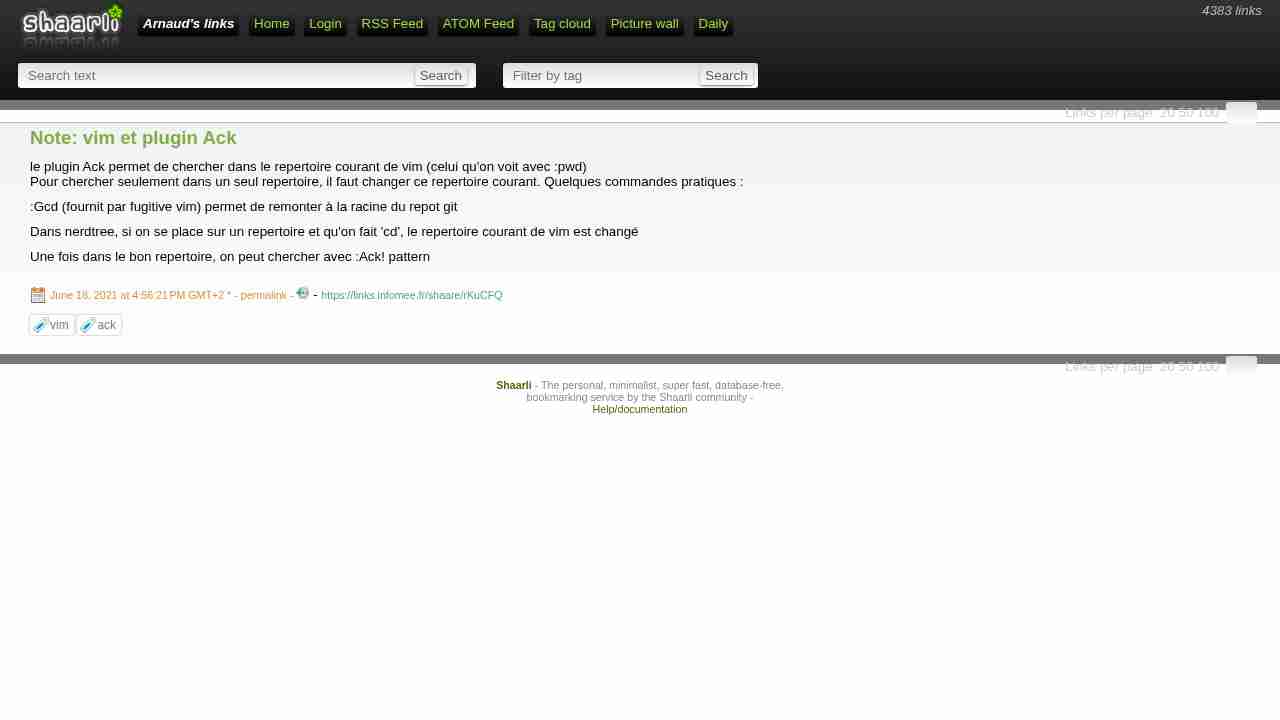
Note: vim et plugin Ack
June 18, 2021 - permalink - https://links.infomee.fr/shaare/rKuCFQle plugin Ack permet de chercher dans le repertoire courant de vim (celui qu'on voit avec :pwd)
Pour chercher seulement dans un seul repertoire, il faut changer ce repertoire courant. Quelques commandes pratiques ::Gcd (fournit par fugitive vim) permet de remonter à la racine du repot git
Dans nerdtree, si on se place sur un repertoire et qu'on fait 'cd', le repertoire courant de vim est changé
Une fois dans le bon repertoire, on peut chercher avec :Ack! pattern
-
-
-
-
-
-
-