-
shell - How to select lines between two marker patterns which may occur multiple times with awk/sed - Stack Overflow
November 5, 2018 - permalink - https://stackoverflow.com/questions/17988756/how-to-select-lines-between-two-marker-patterns-which-may-occur-multiple-times-wUse awk with a flag to trigger the print when necessary:
$ awk '/abc/{flag=1;next}/mno/{flag=0}flag' file
def1
ghi1
jkl1
def2
ghi2
jkl2How does this work?
/abc/ matches lines having this text, as well as /mno/ does.
/abc/{flag=1;next} sets the flag when the text abc is found. Then, it skips the line.
/mno/{flag=0} unsets the flag when the text mno is found.
The final flag is a pattern with the default action, which is to print $0: if flag is equal 1 the line is printed.
For a more detailed description and examples, together with cases when the patterns are either shown or not, see How to select lines between two patterns?.
-
shell - bash / sh script to replace text between some tags/strings in a text file - Unix & Linux Stack Exchange
October 12, 2017 - permalink - https://unix.stackexchange.com/questions/272061/bash-sh-script-to-replace-text-between-some-tags-strings-in-a-text-fileUse
sed '/#start/,/#end/replace_command'
For example, if the file is called myconfig, and you want to replace "allow" with "deny" in that section, you could say
sed '/#start/,/#end/s/allow/deny/' myconfig
example
sed -i -r "//,/<\/elasticConfig>/s,.+,false," file.xml
-
bash - median of column with awk - Stack Overflow
August 2, 2016 - permalink - http://stackoverflow.com/questions/6166375/median-of-column-with-awkThis awk program assumes one column of numerically sorted data:
/usr/bin/env awk
{
count[NR] = $1;
}
END {
if (NR % 2) {
print count[(NR + 1) / 2];
} else {
print (count[(NR / 2)] + count[(NR / 2) + 1]) / 2.0;
}
}Sample usage:
sort -n data_file | awk -f median.awk
-
-
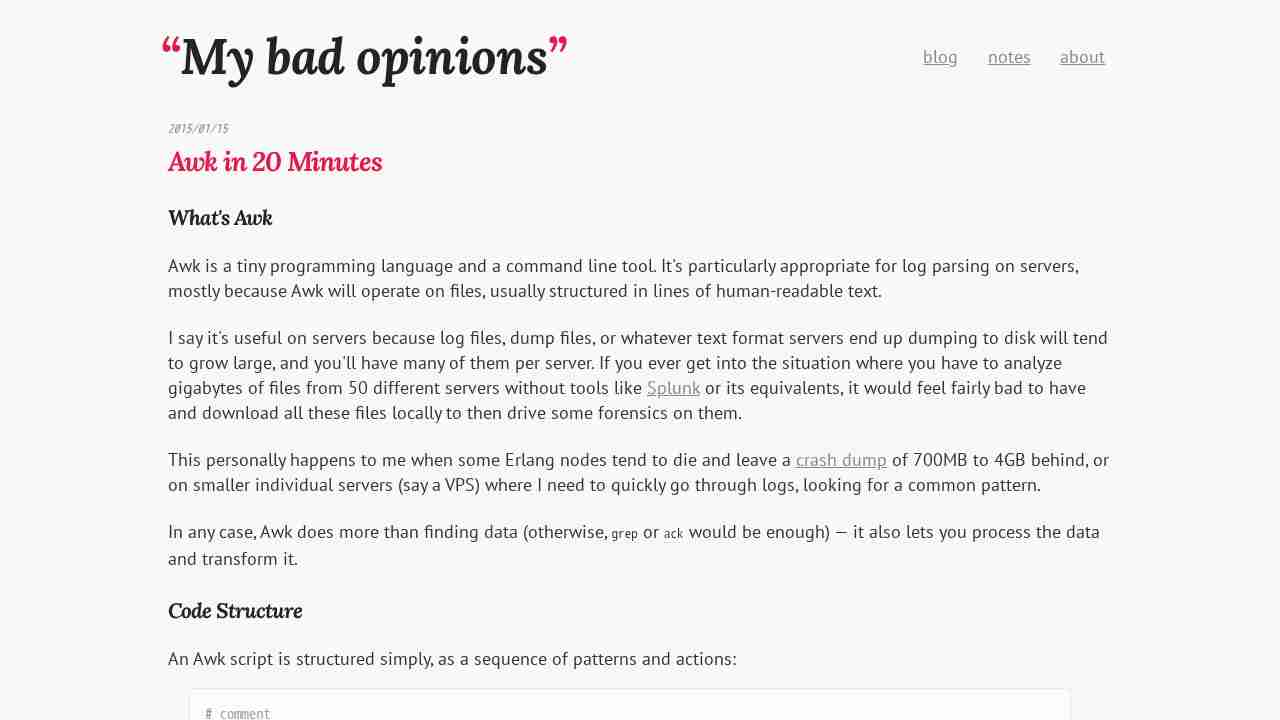
ferd.ca -> Awk in 20 Minutes
January 18, 2015 - permalink - http://ferd.ca/awk-in-20-minutes.htmlCe tuto est bien fait
Mais j'ai un peu de mal avec awk : pour des tâches simple je m'en sors avec cut, et pour des tâches plus complexes je passe à un vrai langage de scripting comme python
-
-
linux - Add up a column of numbers at the Unix shell - Stack Overflow
November 19, 2014 - permalink - http://stackoverflow.com/questions/926069/add-up-a-column-of-numbers-at-the-unix-shell| awk '{total = total + $1}END{print total}'
find . ! -newer /tmp/file2015 -exec ls -l --block-size=M {} \; |cut -d' ' -f5|sed 's/M//'| awk '{total = total + $1}END{print total}'
-
-
-