-
-
Argo CD test Health Checks Locally
November 22, 2026 - permalinkTest Health Checks Locally
ArgoCon North America
Command
argocd admin settings resource-overrides health degraded.yaml --argocd-cm-path argocd-cm.yamlOutput
STATUS: Degraded
MESSAGE:
DEMO_STATEis brokenExplanation
degraded.yamlis the resource to evaluate, saved as a plain YAML file.--argocd-cm-path argocd-cm.yamlreads the Lua health checks from a local file instead of the cluster'sargocd-cm.
-
-
How Claude remembers your project - Claude Code Docs
November 21, 2026 - permalink - https://code.claude.com/docs/en/memoryAudit your instruction files
To have Claude check your instruction files for outdated or conflicting content, run /doctor prompt-audit in a session. Claude looks for problems such as instructions written for older models, references to files or commands that don’t exist, and files that contradict each other. You get a report of findings with proposed edits, and nothing in your files changes until you ask Claude to apply them.
-
-
-
-
-
Meta Wins CNCF End User Case Study Contest for Accelerating AI Infrastructure Deployments From Hours to Minutes | CNCF
November 16, 2026 - permalink - https://www.cncf.io/announcements/2026/11/11/meta-wins-cncf-end-user-case-study-contest-for-accelerating-ai-infrastructure-deployments-from-hours-to-minutes/
-
GitHub - Graphify-Labs/graphify: Turn any codebase, with its docs, SQL schemas, configs, and PDFs, into a queryable knowledge graph. A /graphify skill for Claude Code, Cursor, Codex, and Gemini CLI: local deterministic AST parsing, every edge explained, no vector store. · GitHub
November 15, 2026 - permalink - https://github.com/Graphify-Labs/graphify
-
-
-
-
-
-
-
-
-
-
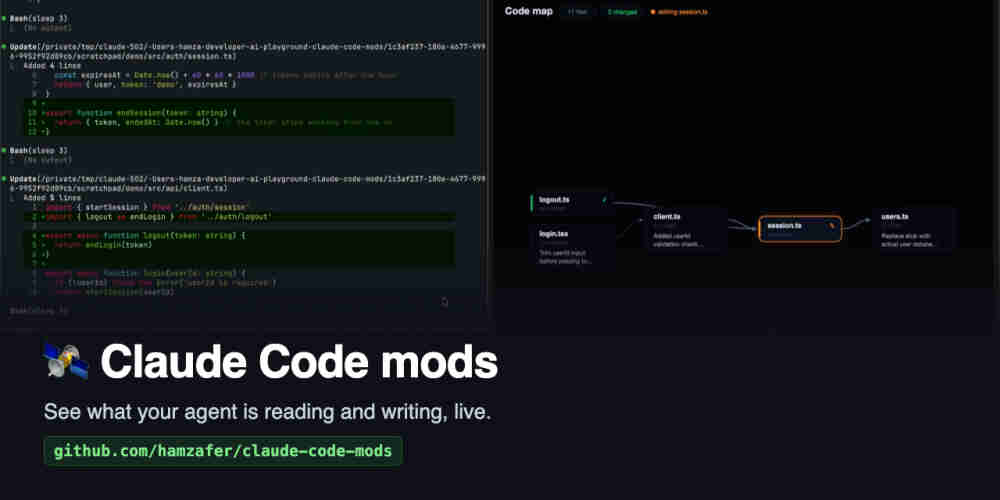
hamzafer/claude-code-mods: Claude Code mods: plugins built on hooks that add live lines above the prompt, guards, panes and games. Context bar, usage meter, Codex review watch, Markdown preview, Spotify now playing and more.
November 8, 2026 - permalink - https://github.com/hamzafer/claude-code-mods/tree/maina repo with few mods that work together
claude mods
-
-
-
- YouTube
November 2, 2026 - permalink - https://www.youtube.com/watch?v=GP6hHdwstdYLeopold Aschenbrenner
Situational Awareness
-
-
Module Blocks | OpenTofu
October 31, 2026 - permalink - https://opentofu.org/docs/language/modules/syntax/modules installed from a module registry, such as the Public OpenTofu Registry or any TACOS (TF Automation and Collaboration Software) private modules registry. Other module sources can provide their own versioning mechanisms within the source string itself, or might not support versions at all. In particular, modules sourced from local file paths do not support version; since they're loaded from the same source repository, they always share the same version as their caller.
-
-
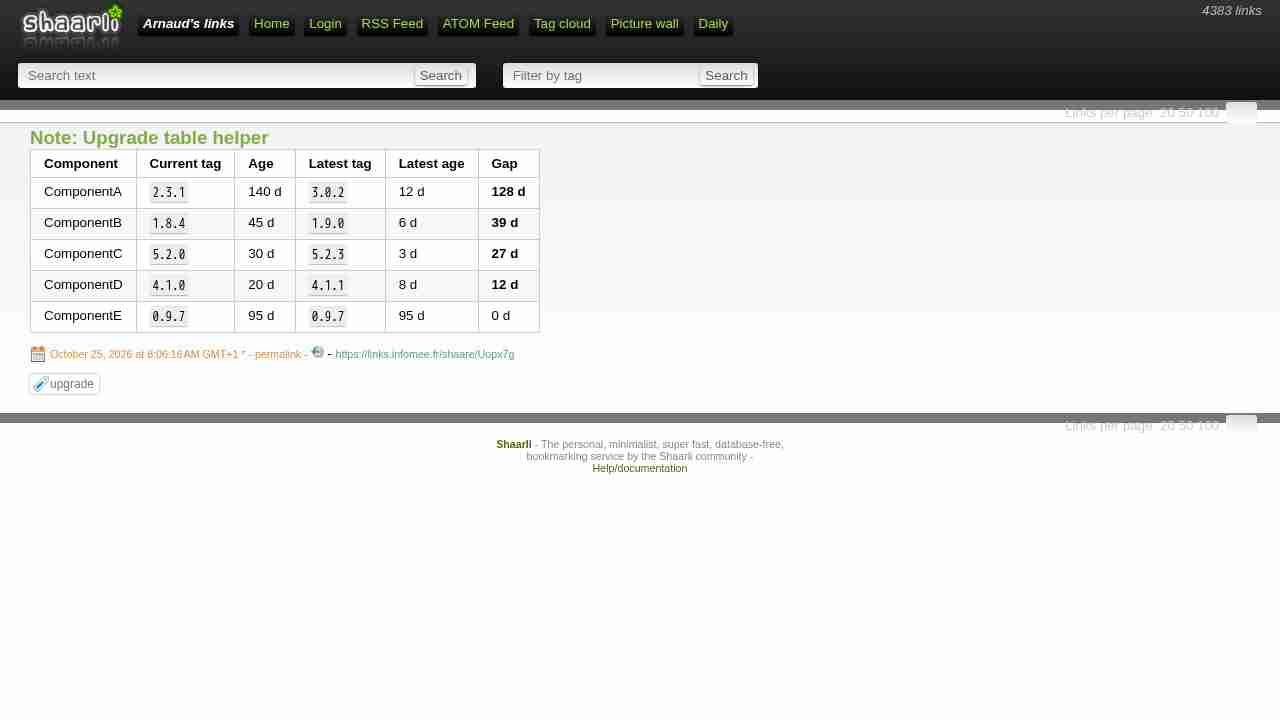
Note: Upgrade table helper
October 25, 2026 - permalink - https://links.infomee.fr/shaare/Uopx7g| Component | Current tag | Age | Latest tag | Latest age | Gap |
|---|---|---|---|---|---|
| ComponentA |2.3.1| 140 d |3.0.2| 12 d | 128 d |
| ComponentB |1.8.4| 45 d |1.9.0| 6 d | 39 d |
| ComponentC |5.2.0| 30 d |5.2.3| 3 d | 27 d |
| ComponentD |4.1.0| 20 d |4.1.1| 8 d | 12 d |
| ComponentE |0.9.7| 95 d |0.9.7| 95 d | 0 d |
-
-
GitHub - cathrynlavery/diagram-design: Editorial diagram design for Claude Code, Codex, GitHub Copilot, Cursor, Factory Droid, Qoder, and Pi. 45 diagram types. Self-contained HTML SVG. No shadows. No Mermaid slop. · GitHub
October 21, 2026 - permalink - https://github.com/cathrynlavery/diagram-design
-
Superpowers skill
October 21, 2026 - permalink - https://github.com/obra/superpowers#how-it-worksUsing this one for quite some time now and it's rly cool
-
-
-
-
-
GitHub - kubernetes-sigs/node-readiness-controller: Declarative node readiness for Kubernetes - gate scheduling with taints until node infrastructure (CNI, GPU, storage, custom checks) is actually ready. · GitHub
October 11, 2026 - permalink - https://github.com/kubernetes-sigs/node-readiness-controller[Summary, full note in Shaarli]
Karpenter: make nodes schedulable only once required DaemonSets are Ready
Approach: a startup taint plus the Node Readiness Controller (https://github.com/kubernetes-sigs/node-readiness-controller). No fixed sleep; keep NodeReady separate from workload initialization.
- NodePool startup taint (only on the relevant NodePools; existing nodes may not get it):
spec.template.spec.startupTaints: [{key: readiness.example.com/required-daemonsets, value: pending, effect: NoSchedule}] - Install the controller (check the current release and docs):
VERSION=v0.5.0 ; kubectl apply -f .../releases/download/${VERSION}/crds.yaml ; kubectl wait --for=condition=Established crd/nodereadinessrules.readiness.node.x-k8s.io ; kubectl apply -f .../install.yaml - NodeReadinessRule (readiness.node.x-k8s.io/v1alpha1) required-daemonsets-ready: nodeSelector readiness.example.com/enabled="true"; condition readiness.example.com/RequiredDaemonSetsReady requiredStatus "True"; same taint; enforcementMode: continuous (puts the taint back if the condition turns False).
- Allowlist of required DaemonSets in a ConfigMap (e.g. kube-proxy, aws-node or your CNI, ebs-csi-node, node-exporter).
- A reporter DaemonSet (code to write) that, for its node (downward API), sets the condition True only when every required DaemonSet has a Ready pod it owns there, False if one is missing, unready or terminating; unknown = not ready. RBAC: get/list/watch pods, nodes, daemonsets; patch/update nodes/status.
- Every required DaemonSet and the reporter must tolerate the taint; the controller must run on an already healthy node.
- Test on a non-prod NodePool (kubectl get nodepools / nodes / nodereadinessrules): new node tainted, condition True, taint removed; stop a required pod, taint back.
Limits: NoSchedule doesn't evict running workloads (needs a separate policy). Docs: https://node-readiness-controller.sigs.k8s.io/user-guide/getting-started.html , https://karpenter.sh/docs/concepts/nodepools/
- NodePool startup taint (only on the relevant NodePools; existing nodes may not get it):
-
-
-
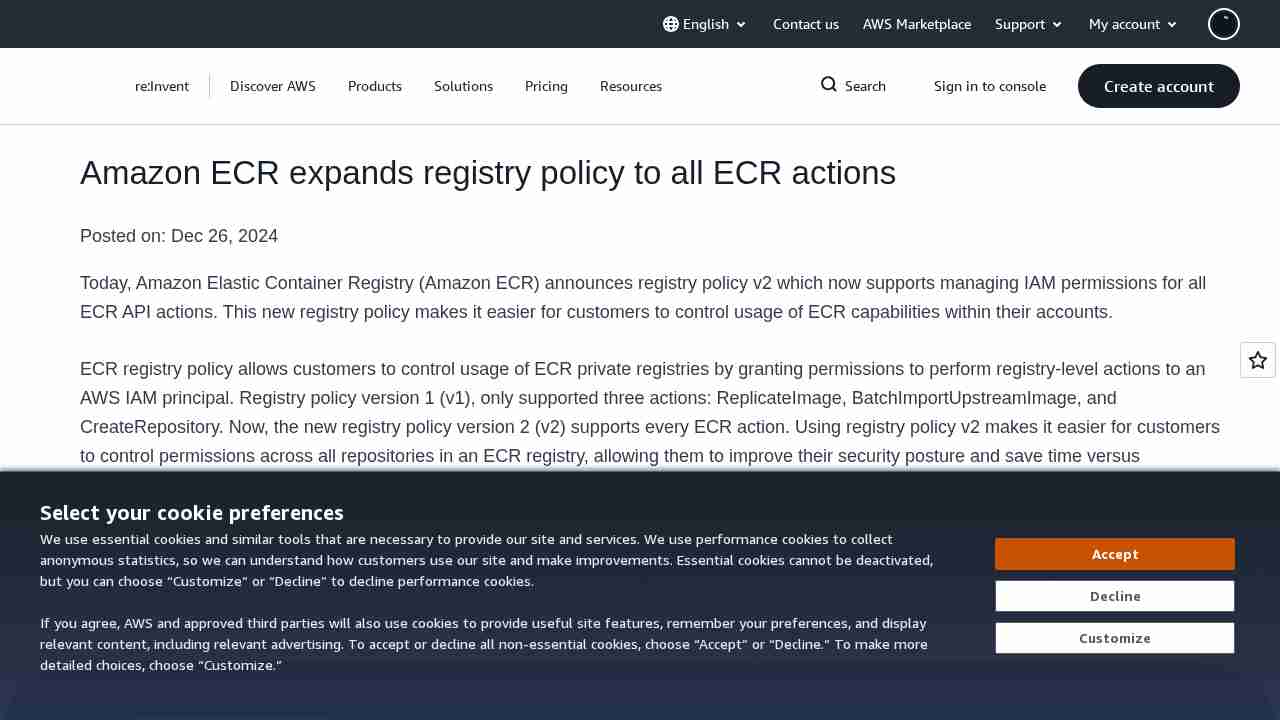
Amazon ECR expands registry policy to all ECR actions
October 4, 2026 - permalink - https://aws.amazon.com/about-aws/whats-new/2024/12/amazon-ecr-expands-registry-policy-ecr-actions/aws ecr get-account-setting --name REGISTRY_POLICY_SCOPE
aws ecr put-account-setting --name REGISTRY_POLICY_SCOPE --value V2
-
-
-
-
-
-
-
-
-
-
-
Istio / Canary Deployments using Istio
March 8, 2026 - permalink - https://istio.io/latest/blog/2017/0.1-canary/Depending on your level of expertise in this area, you may wonder why Istio’s support for canary deployment is even needed, given that platforms like Kubernetes already provide a way to do version rollout and canary deployment. Problem solved, right? Well, not exactly. Although doing a rollout this way works in simple cases, it’s very limited, especially in large scale cloud environments receiving lots of (and especially varying amounts of) traffic, where autoscaling is needed.
-
Istio / Kubernetes Gateway API
March 8, 2026 - permalink - https://istio.io/latest/docs/tasks/traffic-management/ingress/gateway-api/#configuring-a-gatewayapiVersion: v1 kind: ConfigMap metadata: name: gw-options data: horizontalPodAutoscaler: | spec: minReplicas: 2 maxReplicas: 2 deployment: | metadata: annotations: additional-annotation: some-value spec: replicas: 4 template: spec: containers: - name: istio-proxy resources: requests: cpu: 1234m service: | spec: ports: - "\$patch": delete port: 15021